Soft body merge game: balls that squash and settle
Most merge games treat the pieces as solid shapes. In Squish Merge every ball is a soft body: it flattens when it lands, bends when the pile leans on it and leans back when the pile moves. In a soft body game like this one, the softness changes how the pile behaves.
- Free
- No sign-up
- Nothing to install
Loads about 22 MB when you press Play. Nothing to install. Open it on its own page
The game could not start. Check your connection and reload the page.
What soft body means in this merge game
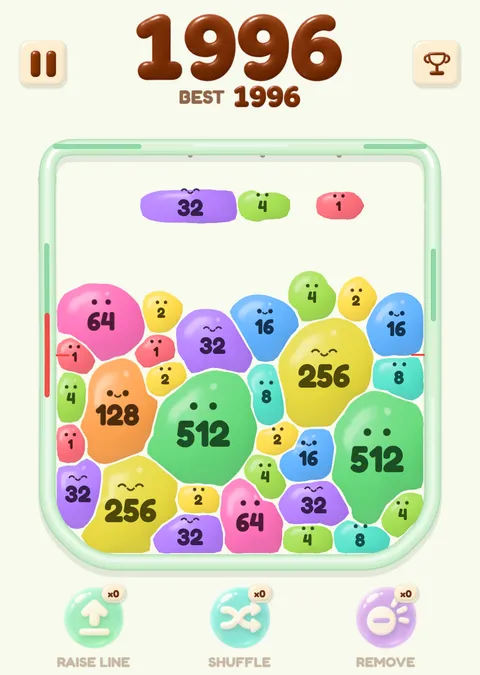
Each ball is soft, not a rigid circle. It can be squeezed and stretched, which is why a ball dropped on the floor of the jar looks flatter for a moment, and why a ball squeezed between two others takes the shape of the gap it is in.
The result is that a pile of balls does not behave like a pile of coins or tiles. It settles slowly, spreads out under its own weight and presses against the walls of the jar and against the plates at the sides.
Aim, hold and launch a soft ball
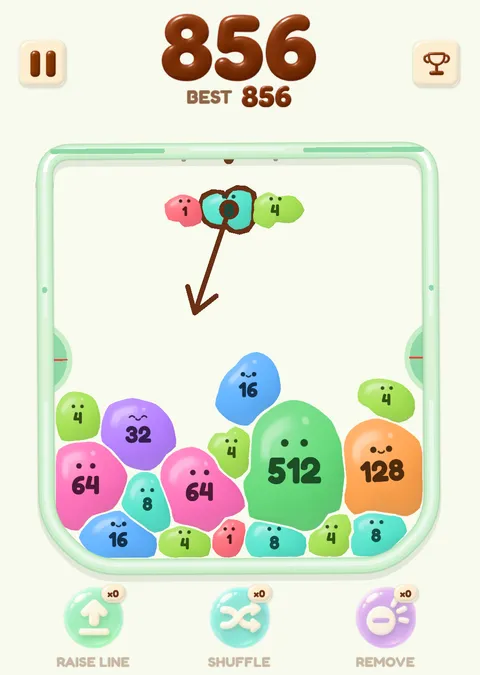
The balls you can launch wait in a row above the jar. With a mouse you hold the left button on a ball, drag to aim and release to launch it; the right button cancels the launch. On a touch screen you press a ball, pull down to aim, release to launch and drag back to cancel. The balls that you are given are numbered 1 to 64, and every bigger number comes from merging.
A ball that arrives hard flattens against what it hits and then relaxes, and the balls around it shift slightly as it does.
The same softness on a phone and on a PC
The balls are soft on every device, but the look differs. A touch screen uses one fixed rounded style, with little eyes on each ball, and you can't change it there. A PC starts with its own default look and can switch skins. Skins change colours and drawing style; they do not change how the balls behave.
The view differs too: the game shows a landscape view on a computer and a portrait view on a phone.
Aiming a soft body merge game ball
Because a ball flattens when it lands and the pile gives under it, the spot where you aimed is where the ball starts, not always where it finishes. A ball that drops into a gap squeezes itself to fit, and it can push its neighbours slightly aside. When you want a ball to end up beside a particular partner, aim for the gap next to it and let it settle in.
A ball that lands softly on top of the pile behaves differently from one that arrives hard. A gentle landing tends to stay close to where it touched. A hard landing flattens, spreads sideways and nudges the balls around it. Watching the first few launches of a round tells you how much give the pile has.
How soft balls merge
When two balls with the same number touch, they do not vanish and get replaced by a new ball. The outlines of the two balls join into one, and the shape settles into a single, larger ball. The new ball is only a little bigger, and the doubled number is written on it.
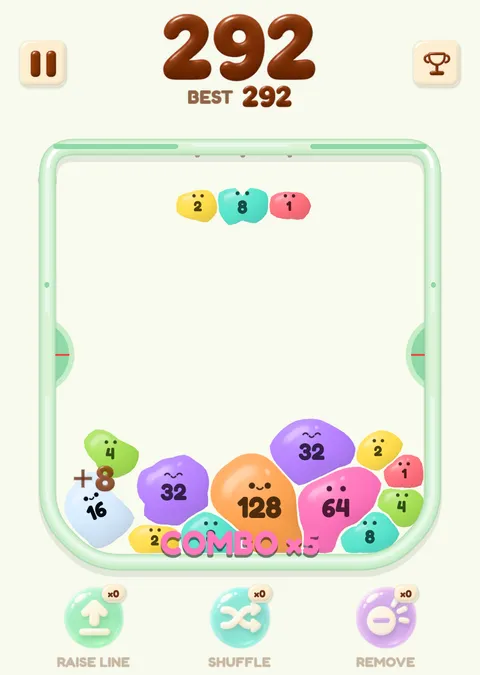
Because merging reshapes the pile, one merge often sets off the next. A 4 that appears next to another 4 merges again, and the chain can run along a whole row of balls. Chains keep the pile low, and a low pile keeps the plates up.
Pressure, plates and the end of a round
There are no timers in the game. A round is lost to pressure. A plate sits on each side of the jar; when the pile pushes a plate all the way down and holds it for 0.5 seconds, that side is full, and when both sides are full the round ends and your score is counted. A pile that grows tall enough leans on both plates.
A tall pile leans and pushes sideways, so keeping the pile even across the width of the jar works better than building a tower.
Pressure builds from the middle outward. Soft balls spread under their own weight, so a heap in the centre slowly widens and meets the plates even if you never place a ball near them. Merging is the way to bring the pile down: two balls become one, and the stack gets lower. If one side is filling faster, aim your next launches at the other side to even it out.
Playing for the feel of it
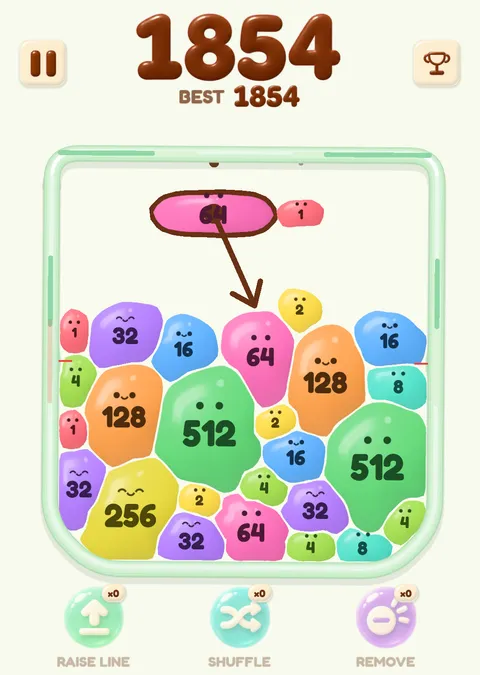
You can play slowly and watch the balls settle, or plan merges several moves ahead.
Press Play above and try a few launches to see how the balls squash. Nothing has to be installed, and the game starts downloading when you press Play.
The home page has the game first and a short guide to the merge game under it.
- Doubling numbers and how big each ball gets: 2048 ball.
- Playing in a browser on a PC, Chromebook or phone: merge games online.
Questions about soft balls
What makes a ball soft?
Each ball is soft. It can be squeezed and stretched, so a ball flattens when it lands, takes the shape of the gap it sits in and pushes back against the balls around it.
Does softness change how I should play?
Yes. A ball does not just stop where it lands: it settles, and the pile around it shifts. Even piles are easier to keep under control than tall ones, because a tall pile pushes sideways onto the plates at the walls.
Do merged balls bounce or pop?
No. Two outlines join into one slightly bigger ball.
Is the soft body effect the same on a phone?
Yes. The balls are soft on every device. Phones use a fixed rounded look with little eyes, while a PC can switch skins.
What ends a round?
Both side plates pushed all the way down and held for 0.5 seconds each. There is no timer, and there is no second chance after that.
How does squash and settle change my aim?
A ball lands with some force, flattens against what it hits and then relaxes, so the spot where it ends up can be a little different from the spot where it first touched. Aim slightly toward the gap you want rather than exactly at it, and watch what the first launches do before you rely on a tight shot.
Why does a tall pile get harder to hold?
Soft balls spread out under their own weight and lean on whatever is next to them. The taller the pile, the more it pushes toward the walls and onto the plates at the sides. A low, even pile spreads that pressure across the width of the jar, which is why it lasts longer than a tower.
Can a merge move the balls around it?
Yes. When two outlines join, the new ball takes up a different shape and size from the two that made it, and the balls around it shift to fit. That can bring two matching balls together, which is how one merge sets off another.
Do all the balls behave the same way?
They all squash and push back the same way. What differs is size: each number is a little bigger than the one before, so a ball for 64 is about twice as wide as the ball for 1.