2048 ball: doubling numbers without a grid
If you have played 2048, you already know the rule at the heart of Squish Merge: two matching numbers join into one number twice as big. What changes is the board. There are no tiles and no grid; each number sits on a soft ball.
The 2048 ball: same doubling, different shape
In 2048 a number lives in a square, and the squares slide on a four by four board. In Squish Merge a number lives on a ball. You launch it into a jar, it lands wherever you aimed, and it rolls and settles against the other balls. Nothing snaps to a position. The only thing the two games share is the arithmetic: 1 and 1 make 2, 2 and 2 make 4, 4 and 4 make 8, and the chain keeps going.
Squish Merge is not a version of 2048. It is a separate game with its own rules for space, size and ending.
Number merge game rules in short
In this number merge game, the balls you can launch wait in a row above the jar. You press one, pull it down to aim and release to launch it. When two balls with the same number touch, they merge into one ball with double the number. Balls with different numbers do not merge, so they simply sit next to each other and take up room.
The balls that start a round are numbered 1 to 64. In the default mode you never receive a bigger ball than that; anything above 64 only appears because you made it by merging.
Doubling numbers, but only a little bigger
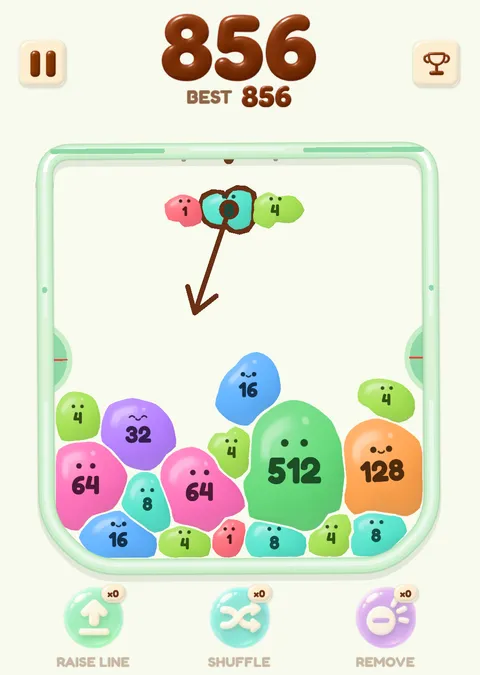
In 2048 every number takes one square, whatever its value. Here a bigger number means a bigger ball, but only slightly. Each number is only a little bigger than the one before. Over many steps this adds up: the ball for 64 is about twice as wide as the ball for 1.
Small and big balls share one jar: the bigger numbers are clearly bigger, but not enormous. Nothing in the game is placed on a grid. A ball lands where you aimed it and settles against its neighbours, and the pile shifts as new balls arrive.
How a ball merge game plays differently
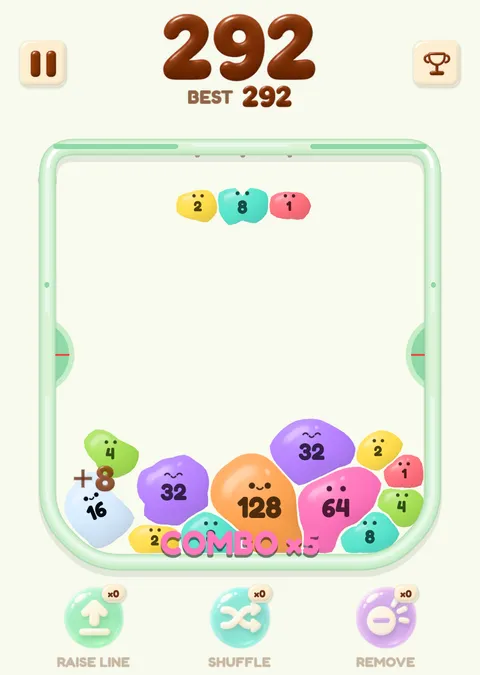
Because balls are round and soft, a ball you launch can come to rest in a gap that a tile never could, and it can be pushed sideways later by the weight of the pile.
Space runs out through pressure, not through a full grid. A round ends when the pile has pushed the plates on both sides of the jar all the way down and held them there for 0.5 seconds each. There is no move counter and no countdown.
Planning merges with a 2048 ball
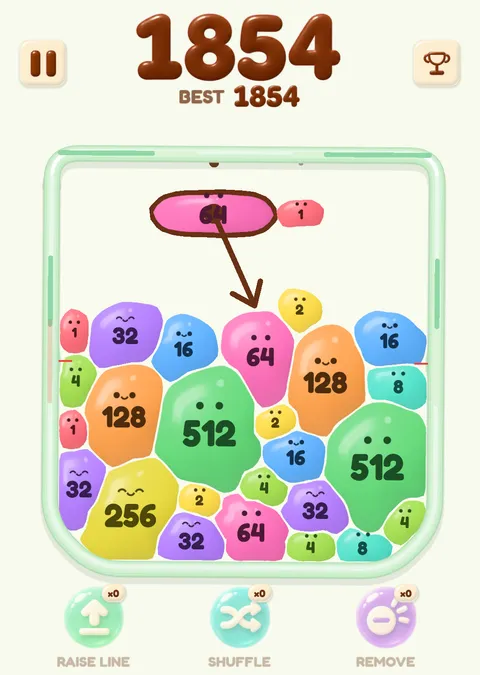
The doubling chain is the same as on a grid, so the habit from 2048 still helps: think one number ahead. If you are about to make a 16, check whether another 16 is close enough to join it. When two merges are possible, take the one that leaves the pile lower and more even.
The difference is that you cannot slide everything at once. Each launch places a single ball, and the soft pile shifts a little around it, so a good placement is one that still works after the pile settles. A ball tucked against its twin tends to stay there; a ball balanced on a bump may roll away.
Order matters in another way, too. The balls waiting above the jar are the only ones you can launch, so look at the row before you commit. If the next ball is the partner for the one in your hand, you can set up a pair rather than spend the second ball elsewhere.
A skin that borrows the look of 2048
One of the game's skins is called 2048 and borrows its colours from the well-known 2048 game: cream and beige, with oranges, yellows and browns for the numbers. On a computer you can switch skins; on a touch screen the look is fixed, so you will not see the choice on a phone. The skin changes colours only; the balls are still soft and round.
Try the doubling yourself
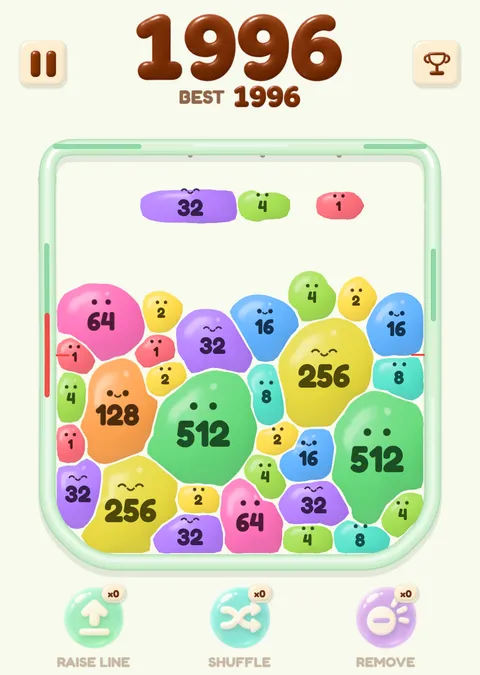
The quickest way to see how the 2048 ball works is to play a round. Press Play below, launch a 1 at another 1, and watch the 2 appear. Aim for matching neighbours rather than for a tall pile, and keep the number of different sizes in the jar small.
Loads about 22 MB when you press Play. Nothing to install. Open it on its own page
The game could not start. Check your connection and reload the page.
The home page has the game first and a short guide to the merge game under it.
- How soft balls squash, settle and merge: soft body merge game.
- Playing in a browser on a PC, Chromebook or phone: merge games online.
- Who makes the game: sobosuba online.
Questions about the 2048 ball
Is this a new version of 2048?
No. It is a separate game, Squish Merge. It shares the doubling idea with 2048, where matching numbers join into one that is twice as big, but it uses soft balls in a jar instead of tiles on a grid, and the rules for space and for ending a round are different.
What is the biggest number I can make?
Only balls numbered 1 to 64 are ever handed to you in the default mode, and every bigger number is one you made by merging. The game does not set a target number to reach; the aim is a high score and a pile you can keep under control.
Why do the balls only grow a little?
Each number is only slightly bigger than the one before it. Bigger numbers still look bigger, but a high number does not fill the jar.
Can I change the colours?
On a PC or laptop you can switch skins. Touch screens use one fixed soft look, so you can't change skins on a touch screen.
Is there a move limit or a timer?
No. A round ends only when both side plates have been pushed to the bottom and held there for 0.5 seconds each.
How does doubling play out when there is no grid?
On a grid, a number only meets the squares next to it, so you slide until neighbours match. In the jar, a ball meets whatever it touches after it lands and settles. You do not move the whole board; you choose where one new ball goes, and the pile reacts to it. Two 4s that touch become an 8, and if that 8 touches another 8, they join as well.
How do I plan merges ahead?
Look at the row of balls waiting above the jar and at what is already in the pile. If a 2 is waiting and a 2 sits near the top of the pile, you can place it there for an easy merge. A good habit is to build towards the next number: a 4 beside another 4 is worth more than a 4 dropped between a 1 and a 16.
In what order should balls be stacked?
There is no board edge to push numbers into, so no corner trick like on a grid. A neat order still helps: keep similar numbers close together so that a merge always has a partner nearby, and keep the pile level. Mixed numbers jammed together take up room without making merges.
Can a big ball sit next to a small one?
Yes. Different numbers never merge, they just rest against each other. Since each number is only a little bigger than the one before, a small ball and a large one fit in the same jar without the big one pushing everything aside.